

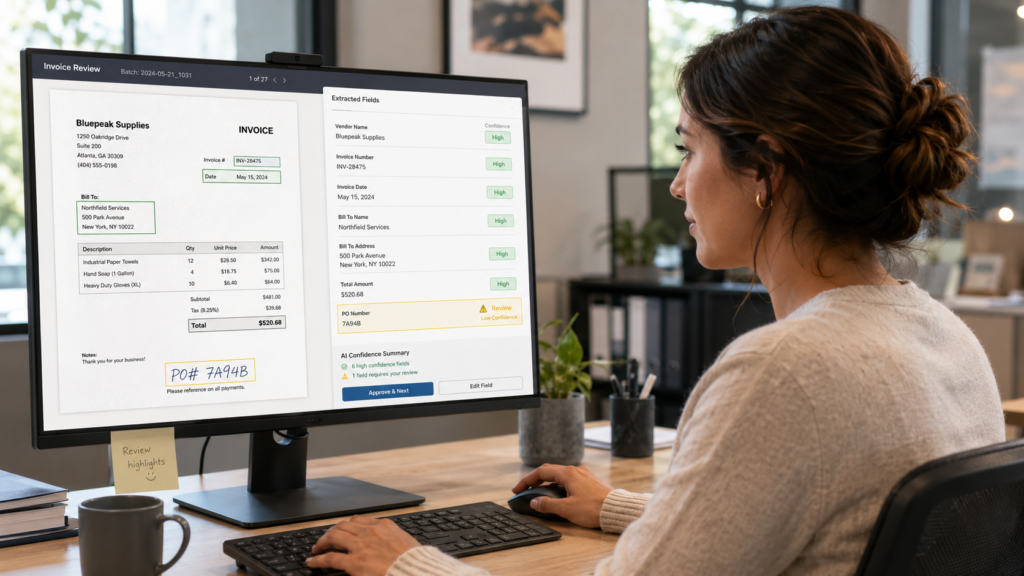
Stay informed with helpful content on AI document processing, document extraction, and smarter business workflows.

AI document processing is the use of artificial intelligence — including machine learning, OCR, and natural language processing — to automatically read, classify, extract, and validate data from documents, then route that data into business systems without manual entry.
Key highlights:
A confidence score is a number a model attaches to one of its own answers. It is the model’s own estimate of how likely that answer is to be correct.
It is shown as a percentage, or a decimal between 0 and 1. A score of 0.92 means the model is fairly sure. A score of 0.35 means it’s mostly guessing.
This idea isn’t unique to documents. It comes from machine learning in general. A model’s final layer often runs the answer through a math function. Softmax handles multi-choice answers. Sigmoid handles yes/no answers. That output becomes the confidence score
Example: An object-detection model that spots a bicycle in a photo with 92% confidence is saying: based on everything I’ve learned, there’s a 92% chance this really is a bicycle. The same logic applies to a document field. A 92% confidence on an extracted date means the model is fairly sure, not certain.
In AI document processing specifically, a confidence score is attached to each individual field pulled from a document — not to the whole document at once.
When the system reads a form, it doesn’t just hand back a name, a date, and an amount. It hands back each of those values along with a number that says how sure it is about that one value.
Example: A scanned utility bill gets processed. The billing address comes back with 96% confidence. The amount due comes back with only 58% confidence, because the print is smudged in that one spot. Both fields were extracted. Only one of them earned real trust. |
This field-level detail is what makes the score useful. A single score for the whole page would hide the fact that one field is shaky while the rest are fine.
It depends on the platform, but functionally, it’s best understood as a feature built into the extraction engine, not a separate add-on module you bolt on later.
Here’s the distinction:
So the score itself is built-in. What you configure is what happens because of the score.
Most systems follow the same basic steps:
This same idea — flag the unclear characters, trust the clear ones — isn’t new. It shows up in OCR error-checking systems from patent filings in the 1990s. That’s long before today’s AI models existed . The mechanism isn’t new. What’s improved is how accurately modern models estimate their own certainty.
A “threshold” is the cutoff point a system uses to decide: pass this through, or send it to a human? Most platforms layer a few different kinds of thresholds together, rather than relying on just one.
Field-Level Threshold
This sets a different bar for each individual field, based on how much that field matters. A high-risk field, like a payment total, can require a stricter cutoff than a low-risk field, like a notes section.
Example: An invoice’s “total amount” field might need 95% confidence to auto-pass. A free-text “notes” field might be fine at 75%, since a wrong note costs far less than a wrong total.
Instead of judging one field, this rolls every field’s score into a single number for the whole document. If that overall number falls below the bar, the entire document gets routed for review, even if only one field was shaky.
Example: A 5-field form where four fields score 99% and one scores 60% might still produce a document-level score low enough to flag the whole form for a quick check.
This sets the bar based on the kind of document, not just what’s inside it. Riskier document types get stricter thresholds than routine ones.
Example: A medical report might need a 95%+ bar before it’s trusted automatically, while a general cover letter might be fine at 80%, since the cost of a mistake is much lower.
Example: A new document type might start with an 85% threshold. After a few hundred reviewed and corrected documents, the system can responsibly tighten or loosen that bar based on real outcomes, not a guess.
| With Confidence Scores | Without Confidence Scores | |
|---|---|---|
| How extractions are treated | Each field gets its own certainty rating | Every field looks the same — no way to tell solid from shaky |
| Review workload | Only the uncertain fields go to a person | Either everything gets reviewed (slow), or nothing does (risky) |
| Error visibility | Low-confidence fields are flagged before they cause problems | Wrong values can pass through with zero warning |
| Scaling automation | Easy to trust more over time as accuracy proves out | Hard to ever fully trust the system, since nothing distinguishes good output from bad |
| Audit trail | Each decision (auto-pass or flagged) is logged with a reason | No record of which fields were uncertain or why |
The core trade-off without this feature: you’re stuck choosing between trusting everything (fast, but risky) or reviewing everything (safe, but slow) — which defeats the point of automating in the first place.

Not every document is created equal. Confidence shifts a lot, based on what kind of text the system is reading.
Document type — how confidence scores shift
| Document Type | What's Happening | Why Confidence Shifts |
|---|---|---|
| Clean digital/typed text | Computer-generated font, no scanning involved | Easiest case. Printed text recognition regularly exceeds 99% accuracy |
| Scanned paper document | Typed text, but now an image | Scan quality, lighting, and skew can lower confidence slightly, even on originally clean text |
| Typo or spelling errors in source | A typo exists in the original document itself | The model reads exactly what's there. A typo in the source isn't an extraction error — the field can score high confidence while still containing the source's mistake. |
| Grammar errors in source | Awkward or incorrect grammar in the original text | Same logic — grammar issues don't usually lower extraction confidence, since the model is reading characters, not judging writing quality. |
| Handwritten text | Cursive or printed handwriting, varies by person | The hardest case for OCR. Handwriting recognition error rates run several times higher than for printed text, since every person's handwriting is different |
| Signatures | A stylized mark, often not legible as text at all | Signatures are usually treated as a separate detection task — "is a signature present?" — rather than a text-extraction task, since most signatures can't be read as words. |
Example: A claims form might have a typed policy number, a typed date, and a handwritten note describing the accident. The typed fields might score 98% confidence each. The handwritten note might score 70%. That one field gets flagged for review, while the typed fields pass straight through.
This is why per-field scoring matters more than a single score for the whole document. A form showing “90% overall confidence” can still be hiding one handwritten field that’s really just a coin flip.
Modern document AI usually combines two different technologies. Each one handles a different part of the confidence picture.
A field’s final confidence score is often a blend of both. One part reflects how clearly the characters were read. The other reflects how confidently the system matched that text to the right field. A handwritten note might score low on the OCR layer, since it’s hard to read. But the LLM layer can still correctly label it as “notes” rather than “policy number.” These are two separate kinds of certainty, working together.
Not everyone needs the same view into this. A few roles typically interact with it directly:
Before connecting confidence scoring to your existing systems, it helps to check a few things first:
Only after these are answered does it make sense to wire the scoring logic into your existing claims system, ERP, or database.
Confidence scoring matters most when the cost of being wrong is high. It also matters when the document volume is too large for a person to check everything by hand.
Example use case: An operations team processes 2,000 incoming forms a week. Without confidence scoring, they face two bad options. They can review every single form, which defeats the purpose of automating. Or they can trust the system blindly, which is risky if even a small share of fields are wrong. With confidence scoring, the system might auto-pass 1,800 forms with no issues. It routes only 200 — the ones with a smudge, a tricky handwritten field, or an unusual layout — to a person. That person spends their day on the 10% that actually needs attention, instead of the full 100%.
Putting this together, the practical support this feature gives day-to-day users looks like:
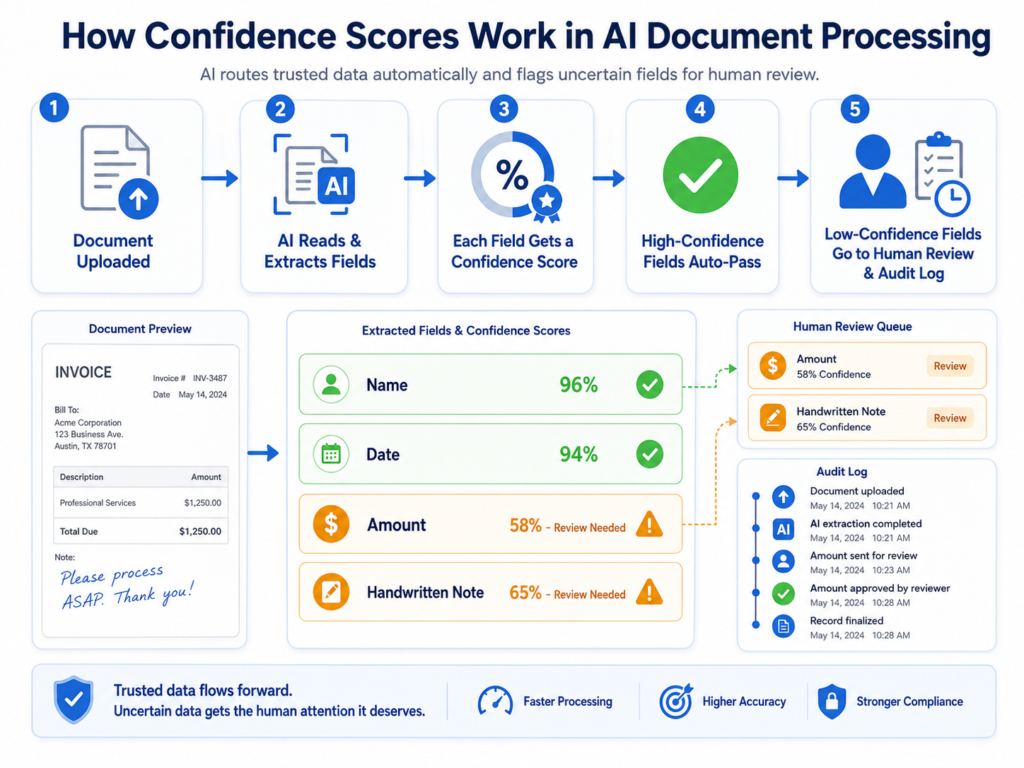
A confidence score doesn’t apply one flat rule to every kind of text issue. It adjusts based on what’s actually happening in that part of the document.
This automatic adjustment is the entire point of the feature: it doesn’t ask a human to decide which fields look risky. It calculates that risk itself, field by field, based on what the model actually encountered.
A few practical tips when setting thresholds or evaluating a tool:
AI document processing is software that uses AI — OCR, machine learning, and NLP together — to automatically read, classify, extract, and validate data from documents, then send that data into business systems without manual entry.
It’s the certainty rating attached to each individual field an AI pulls from a document — a name, date, or amount — not just a single score for the whole page.
The score itself is a built-in feature of the extraction model. The rules around it — thresholds, review queues, dashboards — are often a configurable layer on top.
Not always. Confidence reflects the model’s certainty, not a guarantee of correctness. A well-calibrated system aims to make those two things line up closely, but they aren’t the same thing by definition.
Typed text usually scores very high confidence, often above 99%. Handwriting scores lower and more inconsistently, since handwriting recognition carries meaningfully higher error rates than printed text.